
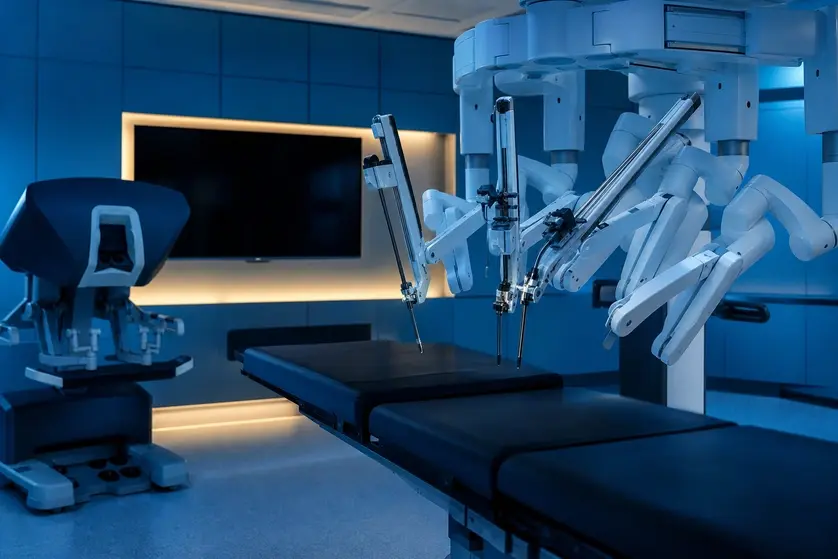
Mr Mohammed Aldiwani performs minimally invasive da Vinci surgery for kidney cancer and benign kidney conditions — with smaller scars, less pain, and a faster recovery. He has a passion for kidney-preserving techniques utilising the latest technology. He is one of few specialist in the country routinely performing retroperitoneal approach robotic surgery.
Royal College of Surgeons Fellowship
Dedicated fellowship in Robotic Kidney surgery at Frimley Renal Cancer Centre
Retroperitoneal Access Specialist
One of very few high-volume retroperitoneal robotic surgeons in the country
Consultant Urological Surgeon
Specialist kidney cancer surgeon
What is robotic kidney surgery?
Robotic kidney surgery uses the da Vinci surgical system to perform minimally invasive operations. Instruments are placed into 4 or 5 small incisions, each 1cm in size. The surgeon sits at a console a few feet away utilising magnified 3D vision inside the body and then controlling robotic instruments with ultra-precise movements inside the body.
Every robotic movement is made by the surgeon in real-time, translating the surgeon’s hand movements on the console, into smaller highly controlled actions at the tip of the instruments.
For patients, robotic surgery can support careful tumour removal, kidney preservation and complex reconstruction for even the most complex cases in a safer way than non-robotic techniques. It can achieve this with smaller incisions, less pain, fewer complications and a shorter recovery compared to previous techniques.
Common Reasons For referral
- Small or complex kidney tumours where partial nephrectomy may be considered
- Larger kidney cancers requiring radical nephrectomy
- Kidney drainage problems such as PUJ obstruction or ureteric stricture requiring robotic reconstruction
- Upper tract urothelial cancer requiring specialist assessment
How You Are Assessed
Every patient is different. The best surgical approach depends on:
01
Size and position of the kidney tumour or obstruction
02
Kidney function
03
Previous abdominal surgery
04
Overall health
05
Findings on CT or MRI imaging
Specialist retroperitoneal robotic surgery
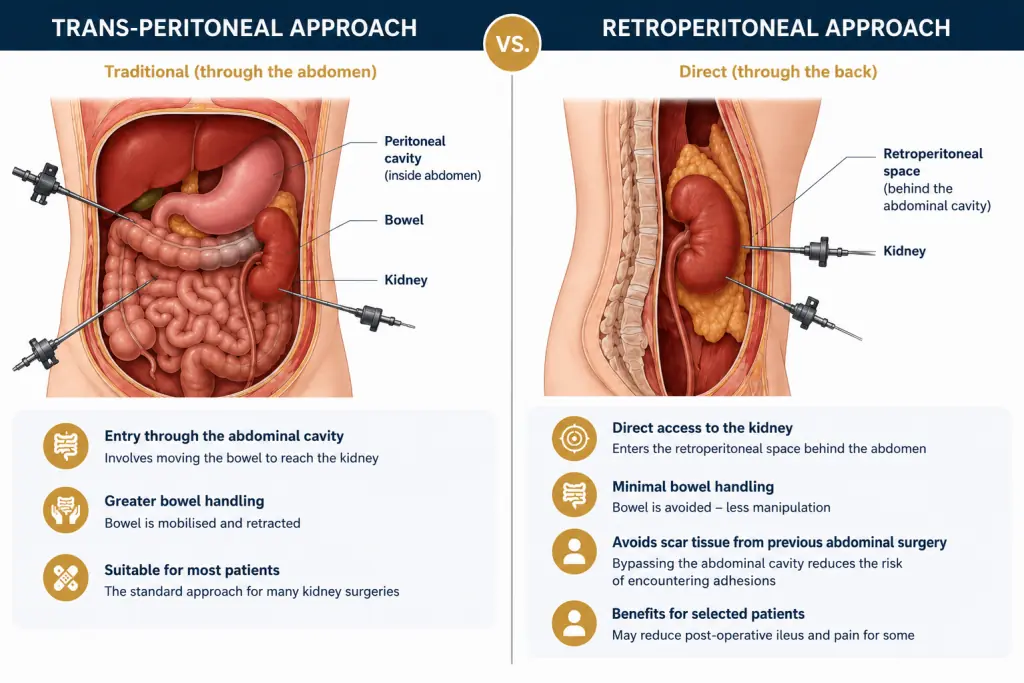
Most kidney surgery is performed by entering the abdominal cavity. A retroperitoneal approach allows direct access to the kidney from behind the abdominal lining. The kidneys and ureters sit behind the abdominal cavity and bowels in an an area referred to as the retroperitoneum. To access these structures, most surgeons performing robotic kidney surgery use a transperitoneal approach from the front of the abdomen, requiring the bowel to be moved before the kidney can be accessed. Mr Aldiwani is one of few surgeons who is trained in the retroperitoneal approach, accessing the kidney directly from the flank and completely avoiding the abdominal cavity. In practice, this technique can be disorientating for those who are not accustomed to it. It is substantially different and requires dedicated training which Mr Aldiwani received in his fellowship at Frimley Renal Cancer Centre. Mr Aldiwani is comfortable with both transperitoneal and retroperitoneal approach and the choice depends on the operation specifics. For partial nephrectomy, Mr Aldiwani performs 90% of his cases via the retro approach.
Advantages of the retroperitoneal approach
- Direct access to the kidney has been shown to have reduced operating time and reduced blood loss
- Avoiding scar tissue in the case of previous surgery making abdominal cavity surgery more difficult and hazardous
- Lowest possibility of bowel related complications after surgery
- Straightforward direct access to back facing tumour
Your Treatment Options
A clear surgical plan depends on tumour size, position, kidney function, imaging and your wider health. The aim is always to personalise the approach. The most common robotic kidney operations performed are:
Robotic Partial Nephrectomy
Removal of a kidney tumour while preserving as much healthy kidney tissue as possible.
Kidney-sparing
Robotic Radical Nephrectomy
Removal of the kidney for larger or more complex kidney cancers when kidney preservation is not suitable.
Established surgery
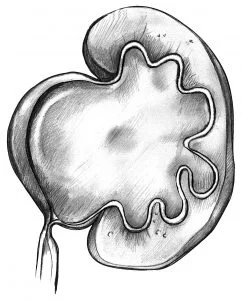
Robotic Pyeloplasty
Reconstruction for kidney drainage blockage, usually PUJ obstruction. Ureteric reconstruction also performed for strictures.
Reconstruction

Robotic Nephroureterectomy
Removal of the kidney and entire length of the ureter for cancers involving the lining of the upper urinary tract.
Complex/referral cases
Frequently asked questions
The questions below explain how private robotic kidney surgery works for patients across Leeds, West and South Yorkshire, when robotic surgery may be suitable, and how the transperitoneal and retroperitoneal approaches differ. Every patient is different. The best surgical approach depends on the size and position of the kidney tumour or obstruction, kidney function, previous abdominal surgery, overall health and the findings on CT or MRI imaging. A specialist assessment is paramount to making the correct decision. For more information on kidney cancer, please see our dedicated kidney cancer information page.
How long is recovery time after robotic kidney surgery?
Recovery varies by operation and patient. Patients typically stay in hospital for 1 or 2 nights. Many patients return gradually to normal activity over 4-6 weeks.
Will I need my whole kidney removed?
Many kidney tumours can be treated with partial nephrectomy, depending on size, position and kidney function. The final decision is a balance of risk determined with the surgeon and patient.
Is retroperitoneal surgery better?
Whilst it may have many advantages, the best surgical approach depends on a number of technical factors. Choosing a surgeon that is experienced in both techniques allows for the best surgical outcome.
Can I have robotic surgery privately in Leeds & Yorkshire?
Yes. Mr Mohammed Aldiwani provides private robotic kidney surgery for patients across Leeds, West and South Yorkshire, utilising the advanced Da Vinci Xi surgical robot at Spire Leeds Hospital. Initial remote or in-person consultations are available to review your imaging and discuss suitability.
Arrange a specialist consultation
For an individualised assessment about kidney surgery including second opinions; robotic surgery opinions, retroperitoneal access suitability or complex upper tract conditions, then please contact us to arrange an appointment.
Recognised by BUPA, AXA, Aviva, Vitality, Cigna, Healix, WPA, and all major private healthcare insurers. If your insurer is not listed, please contact the clinic team to verify coverage.
Quick facts
Best suited to
Small/complex kidney tumours, PUJ obstruction, ureteric stricture, UTUC
Hospital stay
1–2 nights
Anaesthetic
General
Recovery
4–6 weeks to normal activity
Key benefit
Smaller incisions, less pain, kidney preservation where possible